This semester, I taught Argumentation and Advocacy. One of my favorite classes, even if the deductive logic unit tests everyone’s patience. The ongoing challenge is giving students enough debate practice to feel genuinely skilled. Over time, I’ve experimented with a few approaches that seem to work well for both me (in terms of time and grading) and for students (in terms of engagement, challenge, and participation). I wanted to share what’s been most effective.
Student Congress (Congressional Debate)
If you’re familiar with high school Speech and Debate, you may know this format. I use the National Speech and Debate Association’s (NSDA) Congressional Debate Guide as a core resource and structure the unit around a few key assignments:
- An authorship brief/legislation. Each student researches a current issue, identifies stakeholders, explores multiple perspectives, and writes legislation following NSDA guidelines.
- Caucus and Docket Selection. Students create a one-page “poster” of their legislation, participate in a gallery walk to pitch and question ideas, and vote in rounds to narrow the docket to 6–9 items.
- Congressional debate days. I created this “rubric” sheet to track participation and the way that participation happens. I also keep a note sheet where I jot down comments for speakers if warranted (I try to identify both really good things that happen and things that need improvement).
Students really enjoyed this format. It works best with a class of about 28; when my class was larger, it became harder to manage. I’m planning to bring it back next semester.
World Café Dialogues
In the past, I’ve used Living Room Conversations and really enjoyed them. I will likely be returning to those in the future. I find them to be a little overly scripted at times, but I the students feel safer with the structure. But, this semester, I tried World Cafe style. Compared to debate, this format encourages exploration rather than opposition.
I provided a one-page guide for student facilitators and found that the structure worked well when students had prior research. At a public event, however, participants needed more background information to engage fully.
I value dialogue-based activities as a complement to debate. They help students see that argument isn’t always about taking sides. I’ll likely continue using this approach alongside others.
Overall, I really like using these dialogue type activities as a counter to the more conflict oriented debates. Students can see a spectrum of how arguments happen and that it isn’t all based in taking the opposite side and defending it above all else. I will show this video from PBS News Hour to my future Argumentation and Advocacy class. I think it does a really good job describing the unhealthy aspects of debate and how we can be more critical of how we use this really valuable tool when engaging with others. The professor in the video is actually someone who debated competitively and was very successful when I was just out of undergraduate and coaching/judging. I love the idea of starting a program like he has on his campus here at Chico State!
Traditional 1:1 Debates Reimagined
I’ve tried several versions of one-on-one debates over the years. Earlier formats—whether whole-class or recorded—were time-consuming and didn’t give students enough practice.
This semester, I shifted to small groups of four:
- Two students debate while two serve as judges and complete ballots.
- Then they switch roles.
With this structure, students participated far more:
- Two debates per class session
- Multiple rounds across the semester
- Additional experience through dialogues and a public event
With Peer Academic Leaders supporting and circulating, and me doing the same, the level of engagement was high. Students got more practice, and I didn’t feel my direct feedback was as critical as simply increasing repetition and participation. Here are a sample of the slides I used on these days:
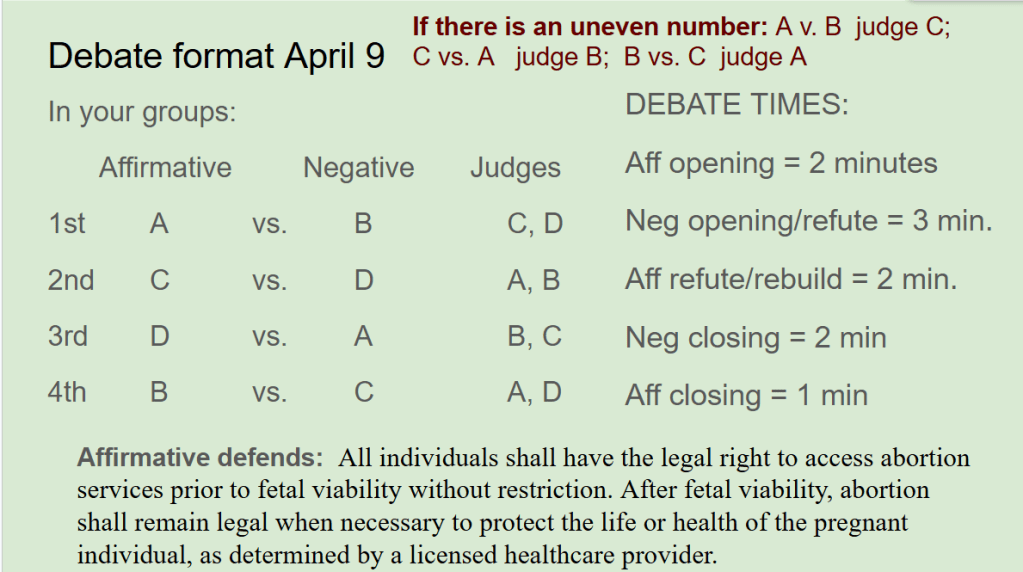
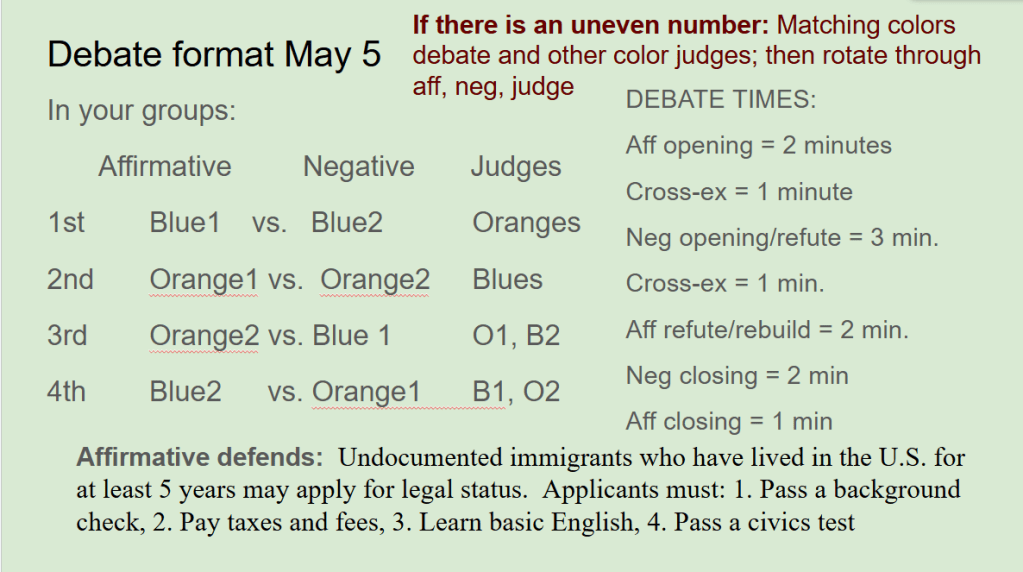
I had Peer Academic Leaders in the classroom and they helped to manage the early debates. They floated around, sat through a debate here and there and gave feedback. I walked around the room and did the same. It was GREAT! So much participation. Students got two debates each DAY and got to judge two debates. So, over the course of the semester they got six debates, plus two World Cafe discussions, plus the public event! I liked it a lot better.
Overall, I plan to continue using all three formats. Each offers something different, and students benefit from that range.
That said, I want to:
- Encourage stronger refutation (students often present parallel arguments without engaging each other)
- Emphasize information literacy, as some sources go unchallenged
- Adjust ballots and rubrics to reward critical engagement with arguments and evidence
If you made it this far, thanks for reading. I hope this gives you a few ideas—or at least a sense of what students can accomplish with the right structure.


Leave a comment